New Stage
| 12 September |
| 19:00 |
| 2026 | Saturday |
|
Le Nozze di Figaro (Opera in four acts) Opera in 4 acts |
|
| Artists |
Credits |
Viktoria Sevryukova, Costume Designer Zinovy Margolin, Set Designer
|
Performed in Italian (with Russian supertitles) Premiere of this production: 25 Apr 2015 The performance has 1 intermission Running time: 3 hours 15 minutes
Mozart's great comic opera of intrigue, misunderstanding and forgiveness has in some ways an instant success. Its bubbling overture, its brilliantly crafted arias—which give insights into the personalities of the characters who sing them—and its lively and intricate ensemble scenes won the hearts of nearly all who witnessed it. Libretto - Lorenzo da Ponte, after the comedy by Pierre-Augustin Caron de Beaumarchais
It seems that while creating Le Nozze di Figaro (English title is The Marriage of Figaro) Mozart and his famous librettist Da Ponte derived formula of a perfect comic opera. You can observe dashingly twisted intrigue with dramatically evolving action, incredibly charming characters, and constant change of clothes... Le Nozze is overflowed with joyful elements of game and carnival; at the same time it has both shrill lyrical moments and profound drama. This opera is loved by singers and conductors (not mentioning music lovers around the world). It is very alluring for directors too: like a complex maze, not easy to calculate the move, but extremely entertaining.
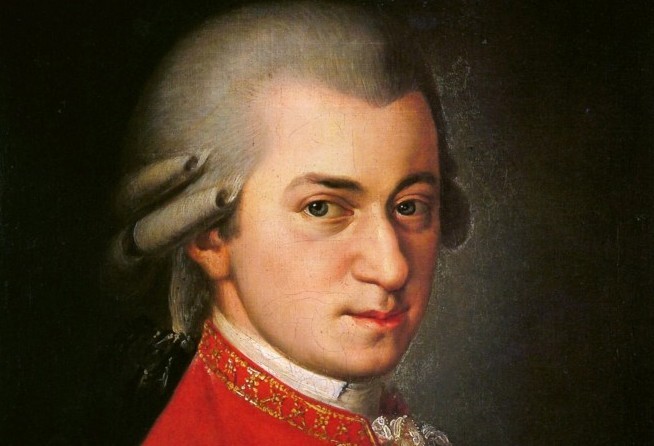
It premiered at the Burgtheater in Vienna on 1 May 1786. Mozart’s friend, Michael Kelly, recalled: “Nobody ever had that tremendous amount of success as Mozart with his Le Nozze di Figaro. Theatre was full; many numbers had to be repeated so it took twice longer to perform than it was supposed to be. Audience wouldn’t stop applauses to Mozart and called encore” . Emperor even had to issue a special direction: to play an encore only certain pieces instead of the entire numbers.
Next year opera premiered in Prague followed by the same phenomenal success. “Everyone talks nothing else but Figaro here; they play nothing, praise, whistle, sing nothing but Figaro, listen to no other operas but Figaro” (extract from Mozart’s letter). This is how triumphal procession of Figaro began around the world.
It dropped by The Bolshoi Theatre, though, with inconceivable and unforgiving delay – first production took place only in 1926! Work was directed by Andrey Petrovsky and conducted by maestro Mikhail Ippolitov-Ivanov. Altogether it was staged at the Bolshoi four times. Groundbreaking record holder was the production by Boris Pokrovsky that stayed in repertoire over twenty years (1956-1978) – within this period it was performed 291 times.
In 2014 William Lacey and Dmitry Belyanushkin presented a semi-staged production that was well received with enthusiasm by both audience in Moscow and St. Petersburg, and led to conquering heart of Norwegian viewer.
Evegeny Pisarev, famous drama director, was invited to work on the new production for the Bolshoi New Stage. He was well familiar with Figaro and his matrimonial worries. In 2014 he staged Le Nozze di Figaro by Beaumarchais at Pushkin Drama Theatre where he was director at the time. It was a tasteful and gentle play that became a total hit. This was his only second time working on opera theatre – as he was saying before premiere, “many ideas on how to tell the story, but I have to bear in mind that it will be sung”.
Evgeny Pisarev:
— Beauty of this opera is that you can flip it by any side – it is amazingly versatile. I personally felt like diving into its festive world.
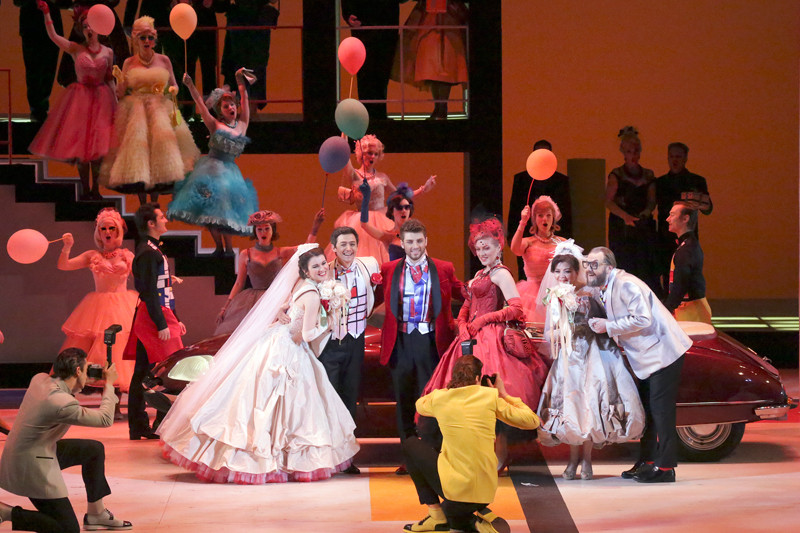
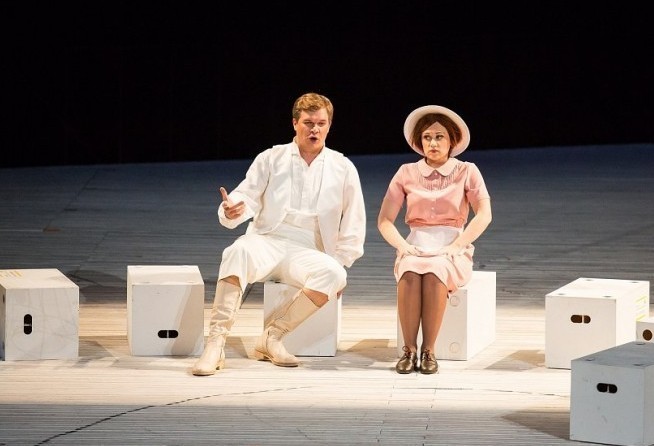
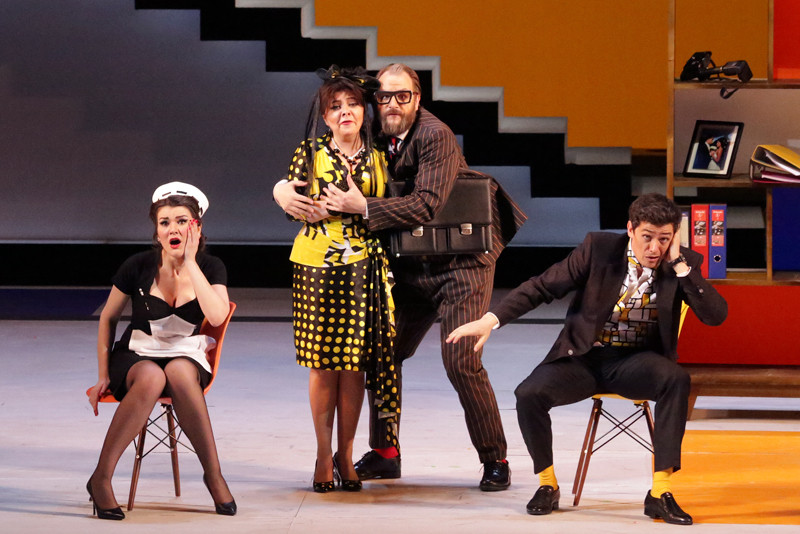
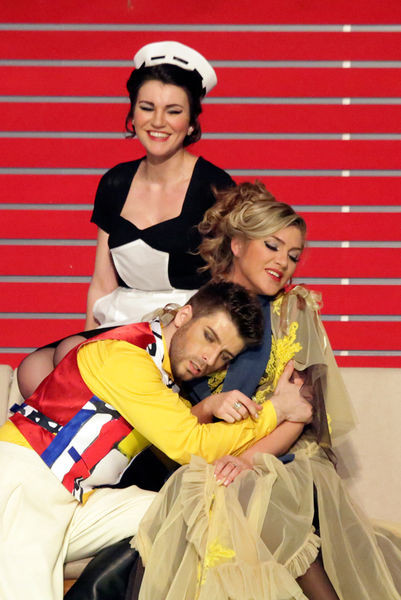
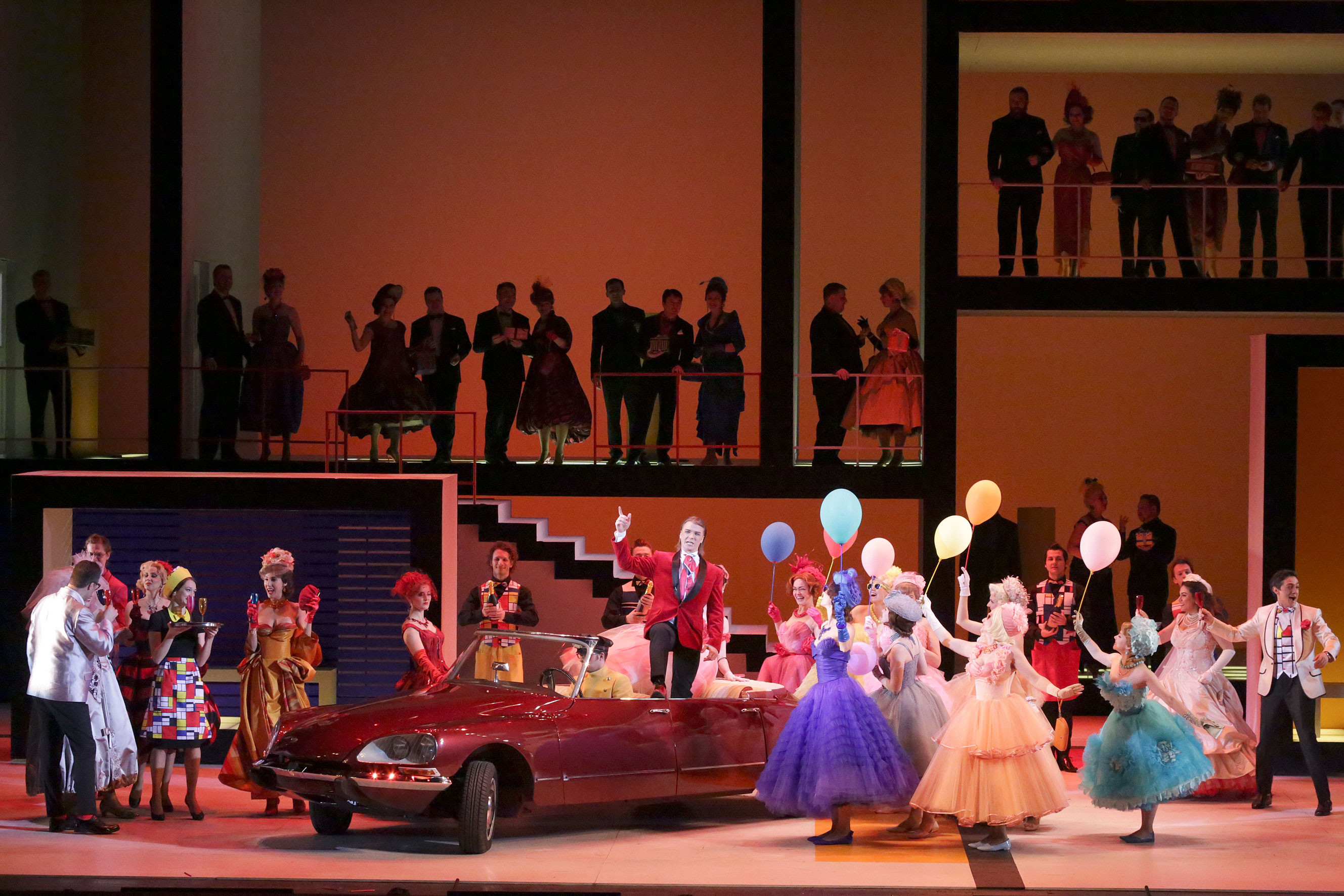
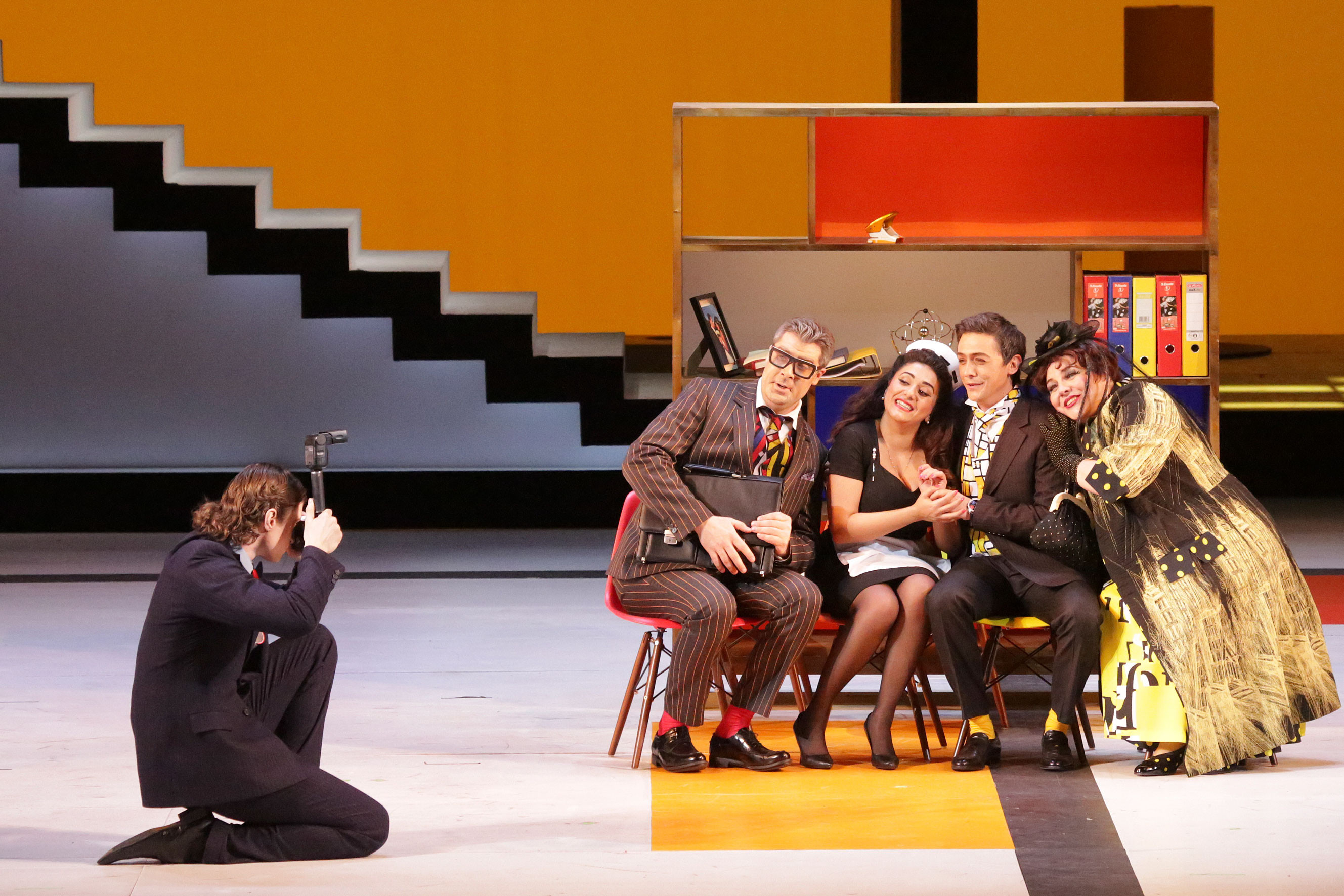
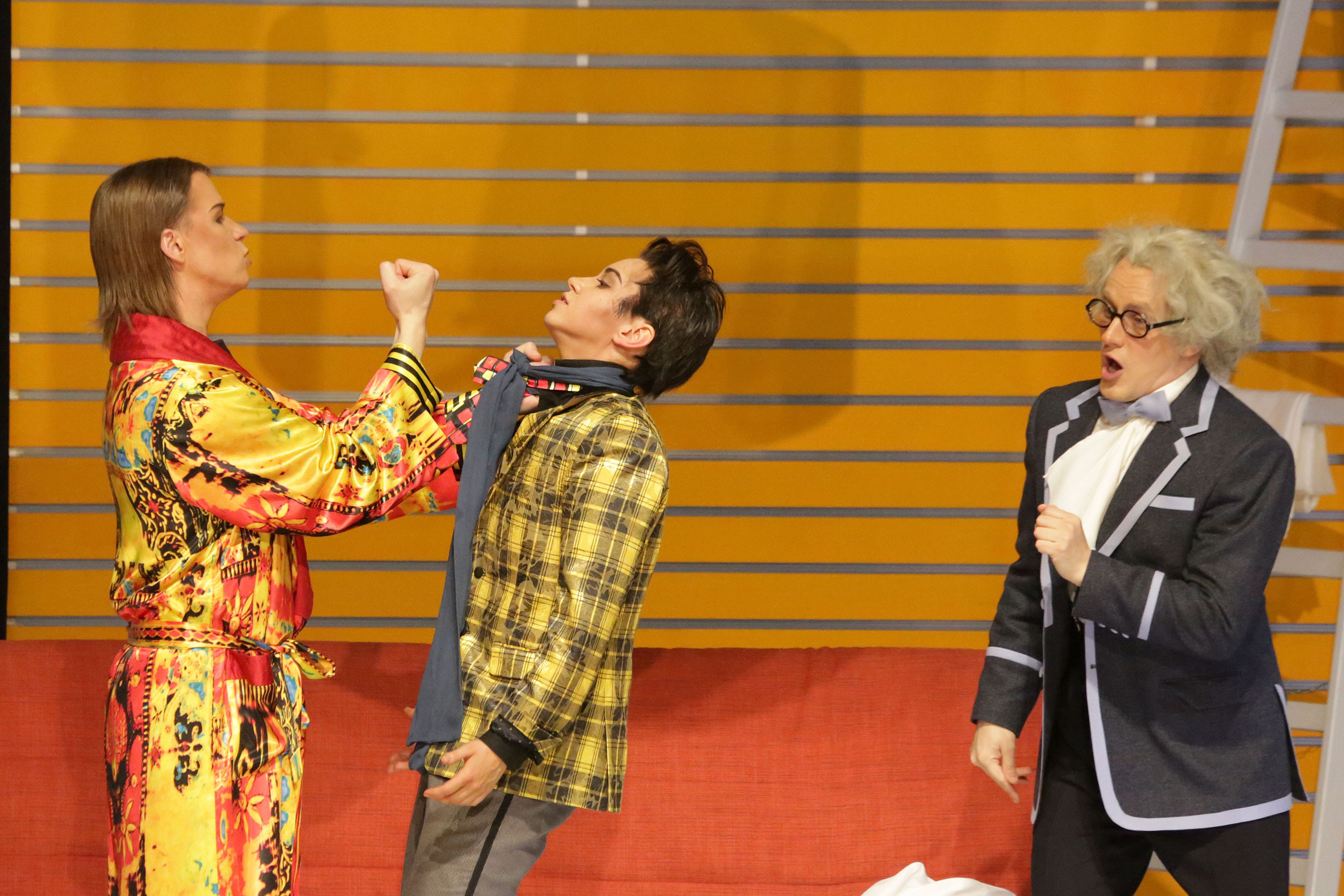
We conditionally placed the set in the middle of XX century – it can be 50s, or 60s, or 70s. It was a post-war period with intrinsic desire for life, joy and feast. Our play will certainly be about love. Because everyone is in love here – Marcellina, Cherubino and even Count himself. They all cheat on one another- but without pain, though, on a contrary – with passion and joy. They can’t handle themselves – too much of testosterone and energy, thirst for pleasure and happiness. I think that’s what you call a Mozartian spirit.
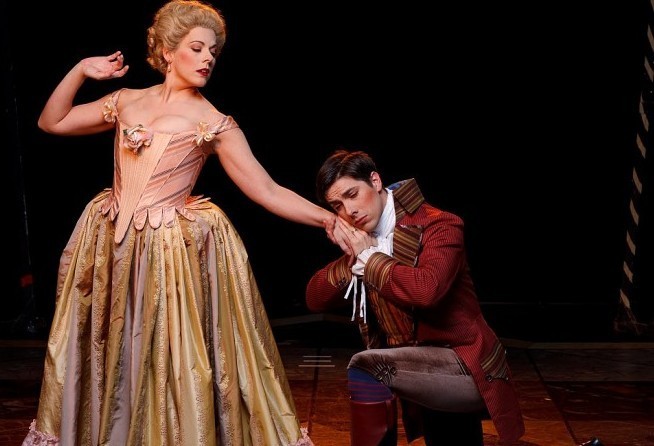
Le Nozze di Figaro is wonderful because of displaying different types of love, different extent of feelings and stages of relationship between man and a woman. Main characters are Figaro and Susanna. Affectionate couple who is in pursuit of happiness whether they are right or wrong; they exchange jokes and do pranks. As the matter of fact, they really take risk, but do everything possible to be together.
I’m trying to take something from Beaumarchais’s comedy. Image of Countess, for instance, is too dramatic at Mozart’s play, no shred of irony in her regards while Beaumarchais offers quite enough of it. That’s why I ask my actresses who are performing this part, to find something funny, awkward even, to avoid portraying her too simple – miserable and suffering. Or, take Marcellina for example. She is a distinctive heroine: she goes through amazing change after giving a birth. Thus, even typical and hilarious characters can out of sudden become warm-hearted and lively in our play.
It is also quite important for me – not to let the play become too common and dull. At the same time characters should be easily relatable. They can drink tea onstage or brush teeth, yet the play should not become plain. It’s like a genre movie of the middle of last century, like Les Demoiselles de Rochefort (English title is The Young Girls of Rochefort) or Les Parapluies de Cherbourg (English title is The Umbrellas of Cherbourg) – beautiful picture, relatable characters, but without realism in full sense of the word. Form and style are still above the reality.
Albert Alberts, choreographer, works with me on this performance, although, there are hardly any dances (except wedding scene). But I request my artists to practically dance their parts, to avoid trivial and simple movements. So roles should not only be played and sung, but danced as well.
I’d like my audience to associate themselves with Figaro. I think anyone can relate to him. He is the main hero and simply a nice person. This is the man who finds a way out of tricky situations, and does it with integrity. Figaro is a very righteous character, he does not suffer, he takes decisions. I generally like this type of active personalities. I have never been fond of Hamlet, for instance. Moreover, Figaro is very close to a present day hero. He is not revolutionary, not idealist, not warrior. With creative approach to life, he never breaks down or compromises his beliefs.
Alexandra Melnikova SynopsisAct I
Figaro and Susanna, servants to the Count and Countess Almaviva, are preparing for their wedding. Figaro is furious when he learns from his bride that the Count has tried to seduce her. He’s determined to have his revenge on his master.
Dr. Bartolo appears with his former housekeeper, Marcellina, who is equally determined to marry Figaro. She has a contract: Figaro must marry her or repay the money he borrowed. When Marcellina runs into Susanna, the two rivals exchange insults.
Susanna returns to her room and an adolescent boy, Cherubino, rushes in. Finding Susanna alone, he tells her he loves her — and every other woman in the house. The Count appears, again trying to seduce Susanna, and Cherubino hides. The Count then conceals himself as well when Basilio, the music teacher, approaches. Basilio tells Susanna that Cherubino has a crush on the Countess. This causes the Count to step forward in anger. He becomes even more enraged when he discovers Cherubino and realizes that his attempts to seduce Susanna have been overheard.
He chases Cherubino into the great hall where they are met by Figaro, who has assembled the entire household to sing the praises of their master. The Count is forced to bless the marriage of Figaro and Susanna. To spite them and to silence Cherubino, he orders the boy to join the army without delay. Figaro ironically tells Cherubino what to expect in the army — no flirting with girls, no fancy clothes, no money, just shells, cannons, bullets, marching, and mud.
Act II
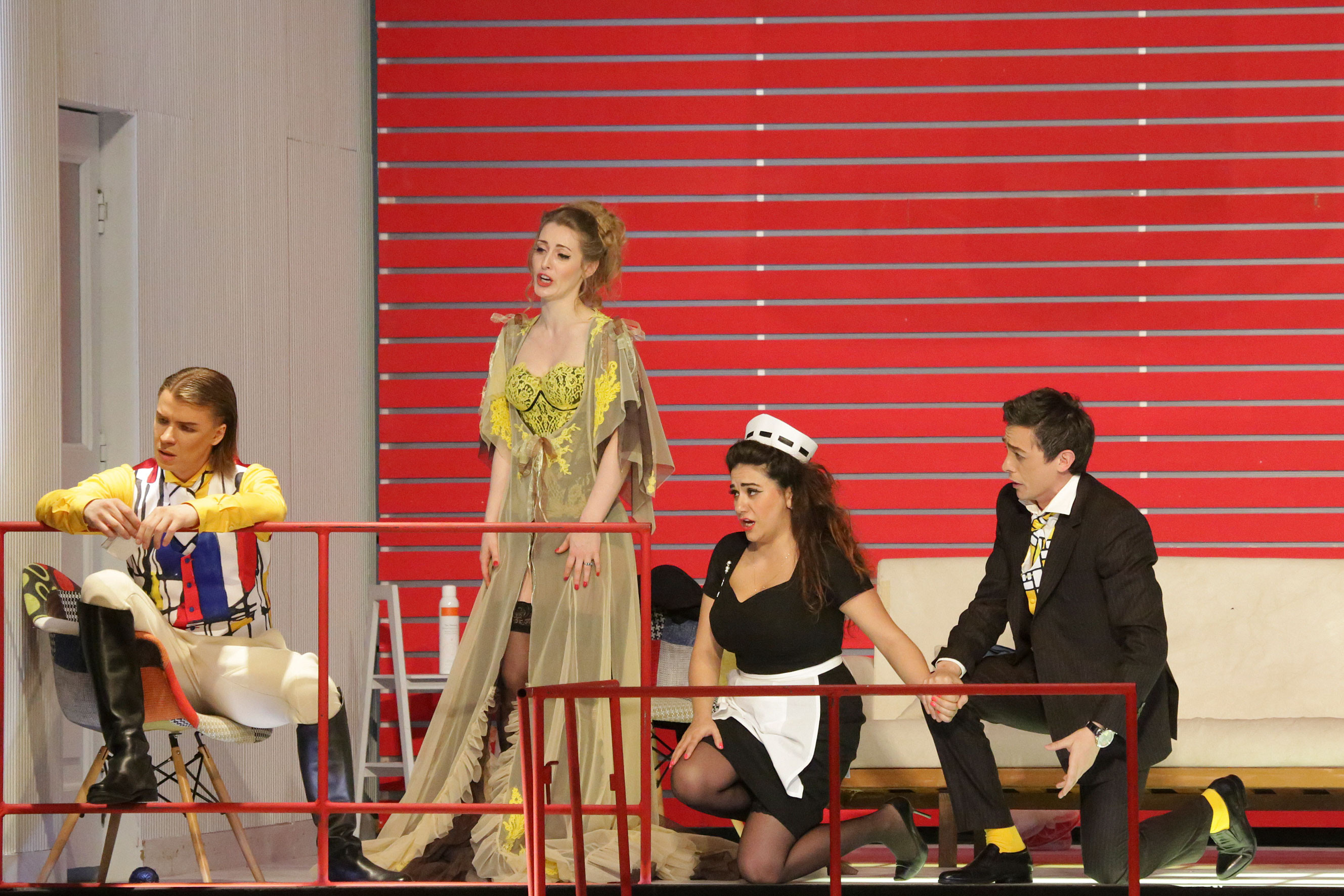
In her bedroom, Rosina, the Countess, mourns the loss of love in her life. Encouraged by Figaro and Susanna, she agrees to set a trap for her husband: they will send Cherubino, disguised as Susanna, to a rendezvous with the Count that night and at the same time make him believe that the Countess is having an assignation with another man. Cherubino appears and the two women lock the door, then begin to dress him up as a girl. While Susanna steps into an adjoining room, the Count knocks and is annoyed to find the door locked. Cherubino shuts himself in the dressing room and the Countess lets her husband in. When there’s a sudden noise from the dressing room, the Count skeptical of his wife’s story that Susanna is in there.
Taking his wife with him, he leaves to get tools to force the door. Meanwhile, Susanna, who has re-entered the room unseen and observed everything, helps Cherubino escape through the window before taking his place in the dressing room. When the Count and Countess return, both are astonished to find Susanna in there. All seems well until the gardener, Antonio, appears, complaining that someone has jumped from the window, ruining his flowers. Figaro, who has rushed in to announce that everything is ready for the wedding, improvises quickly, feigning a limp and pretending that it was he who jumped. At that moment Bartolo, Marcellina, and Basilio arrive, putting their case to the Count and waving the contract that obliges Figaro to marry Marcellina. Delighted, the Count declares that Figaro and Susanna’s wedding will be postponed.
Act III
Later in the day in the great hall, Susanna leads the Count on with promises of a rendezvous that night. He is overjoyed but then overhears Susanna conspiring with Figaro. In a rage, he declares he will have revenge.
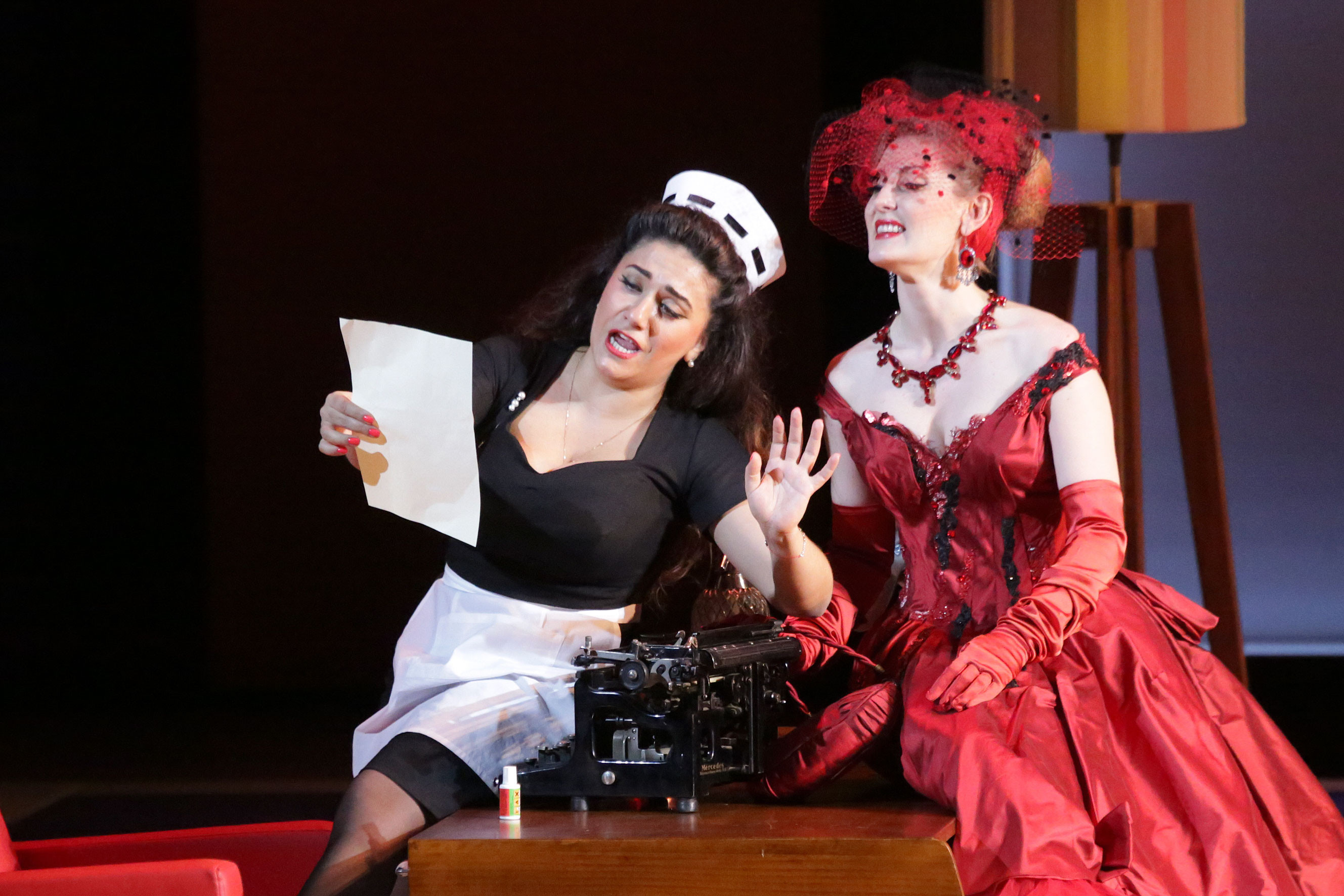
The Countess, alone, recalls her past happiness. She’s determined to go through with the conspiracy against her husband, and she and Susanna compose a letter to him confirming the rendezvous with Susanna that evening in the garden under the pine trees.
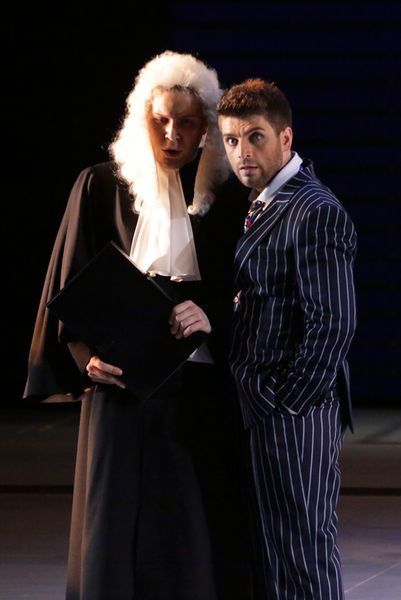
Marcellina, supported by a lawyer, Don Curzio, demands that Figaro pay his debt or marry her at once. Figaro replies that he can’t without the consent of his parents for whom he’s been searching for years, having been abducted as a baby. When he reveals a birthmark on his arm Marcellina realizes that he is her long-lost son, fathered by Bartolo. Seeing Figaro and Marcellina embrace, Susanna thinks her fiancé has betrayed her, but she is pacified when things are explained.
Cherubino, now dressed as a girl, appears with his girlfriend, Barbarina, the daughter of Antonio. Antonio, who has found Cherubino’s cap in the garden, also arrives and unmasks the young man. The Count is furious to discover that Cherubino has disobeyed him and is still in the house. But his anger is punctured by Barbarina—who reveals that the Count, when he attempted to seduce her, promised her anything she wanted. What she wants now is to marry Cherubino. The Count is forced to agree. A march is heard and the household assembles for Figaro and Susanna’s wedding. While dancing with the Count, Susanna hands him the letter, sealed with a pin.
Act IV
At night in the garden, Barbarina is in despair: she has lost the pin that the Count has asked her to take back to Susanna. When Figaro and Marcellina appear, Barbarina tells them about the planned rendezvous between the Count and Susanna. Thinking that his bride is unfaithful, Figaro rants against all women. He hides when Susanna and the Countess arrive, dressed in each other’s clothes. Alone, Susanna sings of love. She knows that Figaro is listening and enjoys making him think that she’s about to make love to the Count. Then she also conceals herself—in time to see Cherubino try to seduce the disguised Countess. The boy is chased away by the Count who wants to be alone with the woman he believes to be Susanna. Figaro, by now realizing what is going on, joins in the joke and declares his passion for Susanna in her Countess disguise. The Count returns. Finding Figaro with his wife, or so he thinks, he explodes with rage. At that moment, the real Countess steps forward and reveals her identity. Ashamed, the Count asks her pardon. After many moments of agonizing doubt, she forgives him and both couples are reunited.
|
Le Nozze di Figaro (Opera in four acts)
on the playbill |
Main Stage
Teatralnaya ploschad, 1 (Theatre Square, 1), Moscow, Russia
New Stage
Bol'shaya Dmitrovka Street, 4/2, Moscow, Russia
RAMT
Teatralnaya ploschad, 2 (Theatre Square, 2), Moscow, Russia
|