Stanislavsky Theatre
| 10 November |
| 19:00 |
| 2025 | Monday |
|
Russian Classical Ballet Stars at the Stanislavski Theatre
Ludwig Minkus "La Bayadere" Ballet in 3 acts Ballet in 3 acts |
|
Premiere of this production: 18 Oct 2013 The performance has 2 intermissions Running time: 3 hours
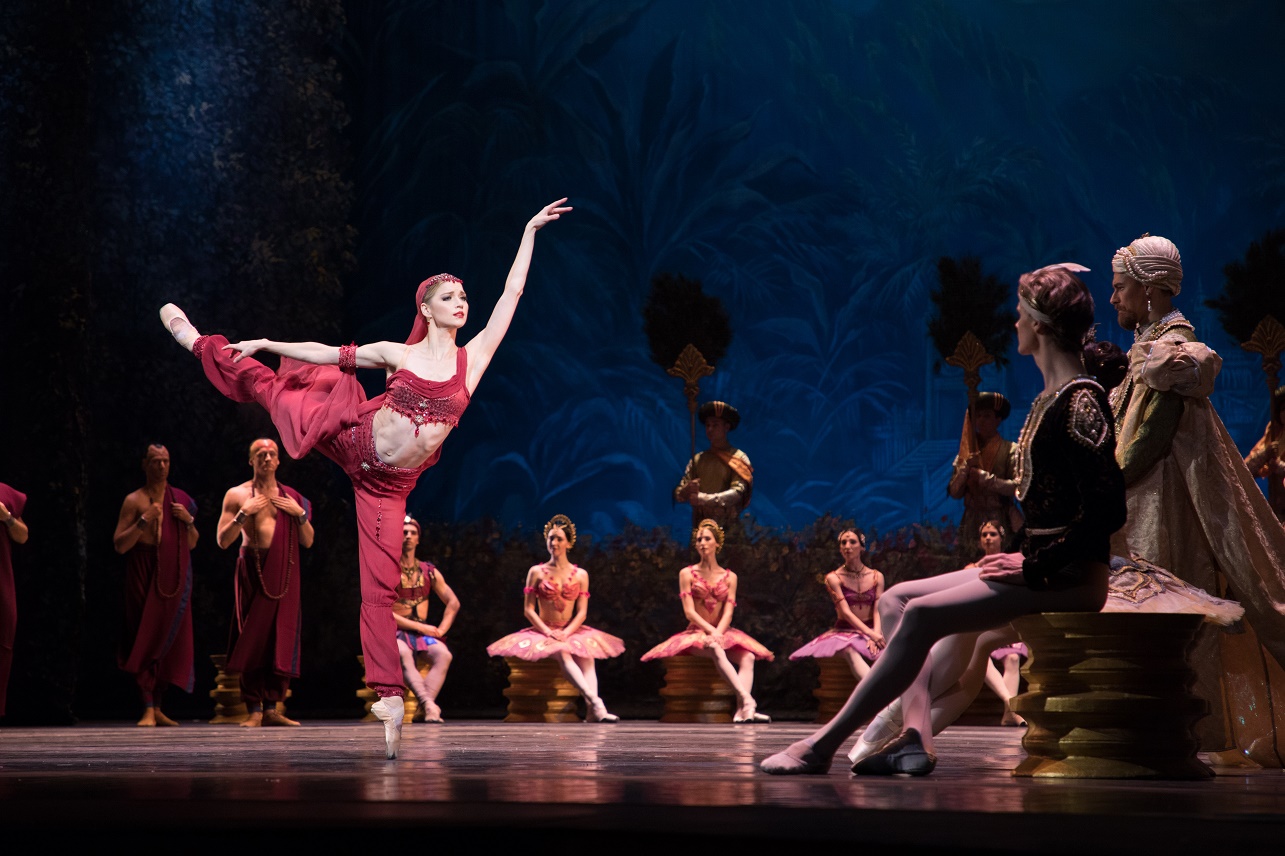
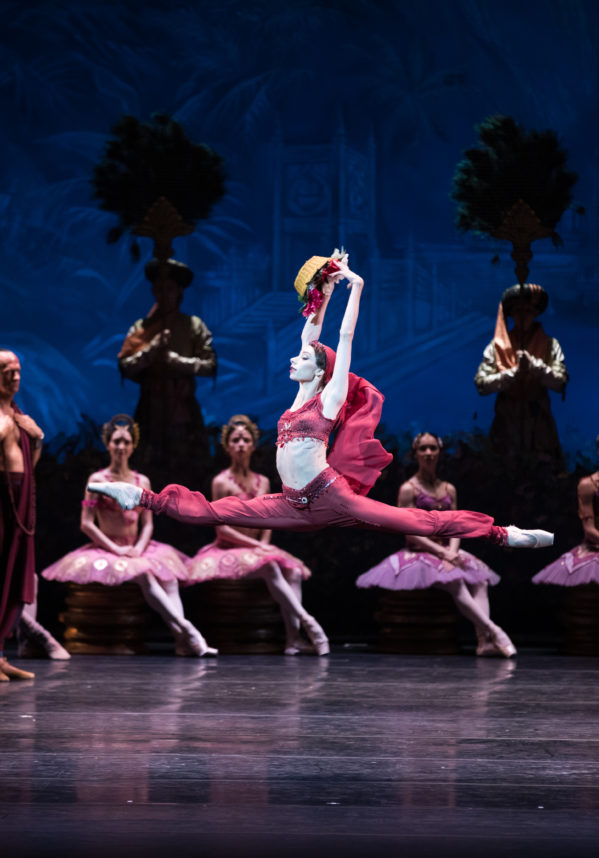
The Stanislavsky Theatre, located in XIX century historical building just 750 metres (9-minute walk) from the Bolshoi, proudly presents this timeless classic with dancers who have performed on the Bolshoi stage and studied in the same world-renowned academies as its leading stars. The celebrated “Kingdom of the Shades” scene, a vision of unparalleled harmony and purity, remains the centerpiece of the ballet, as untouchable as the “white acts” of Swan Lake. Ballet at the Stanislavsky Theatre is the great and affordable alternative to the Bolshoi. Ludwig Minkus and Marius Petipa’s La Bayadère is one of the crown jewels of the Russian Imperial stage, a masterpiece that has inspired generations of ballerinas to embody the tragic heroine, Nikiya. Created in 1877 with a libretto by Sergei Khudekov, the ballet quickly gained legendary status. Every great prima dreamed of the role—an opportunity to dazzle with flawless technique, lyrical expressiveness, and profound dramatic artistry.
Renowned ballerina Natalia Makarova offered her own staging of La Bayadère in 1980. Less pompous and crowded than Petipa’s original, her version preserves the work’s essential poetry and grandeur. Its success has been so enduring that it has been adopted by many of Europe’s most prestigious theatres.
Do not miss the unique opportunity to witness this legendary ballet live on the Moscow stage — a performance where tradition, mastery, and dramatic beauty come together in perfect harmony. SynopsisACT 1
Scene 1. The Sacred Forest surrounding the Temple
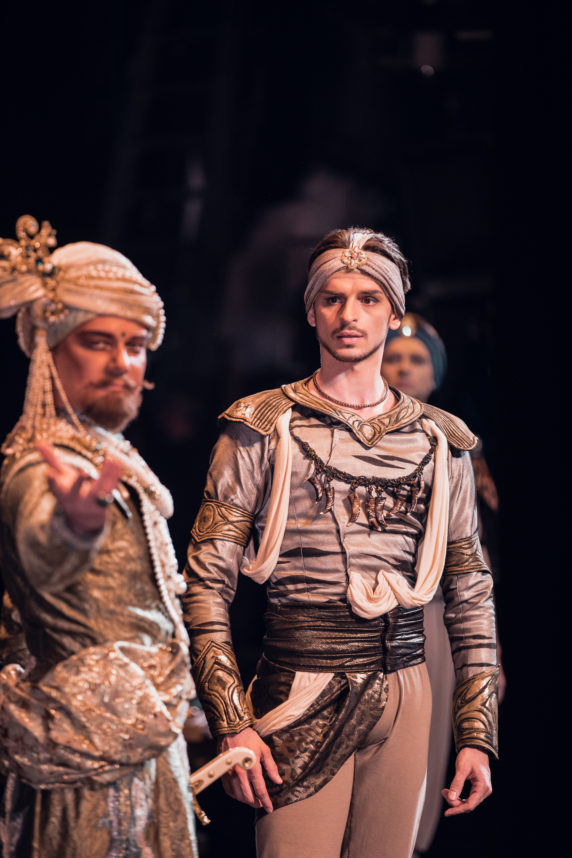
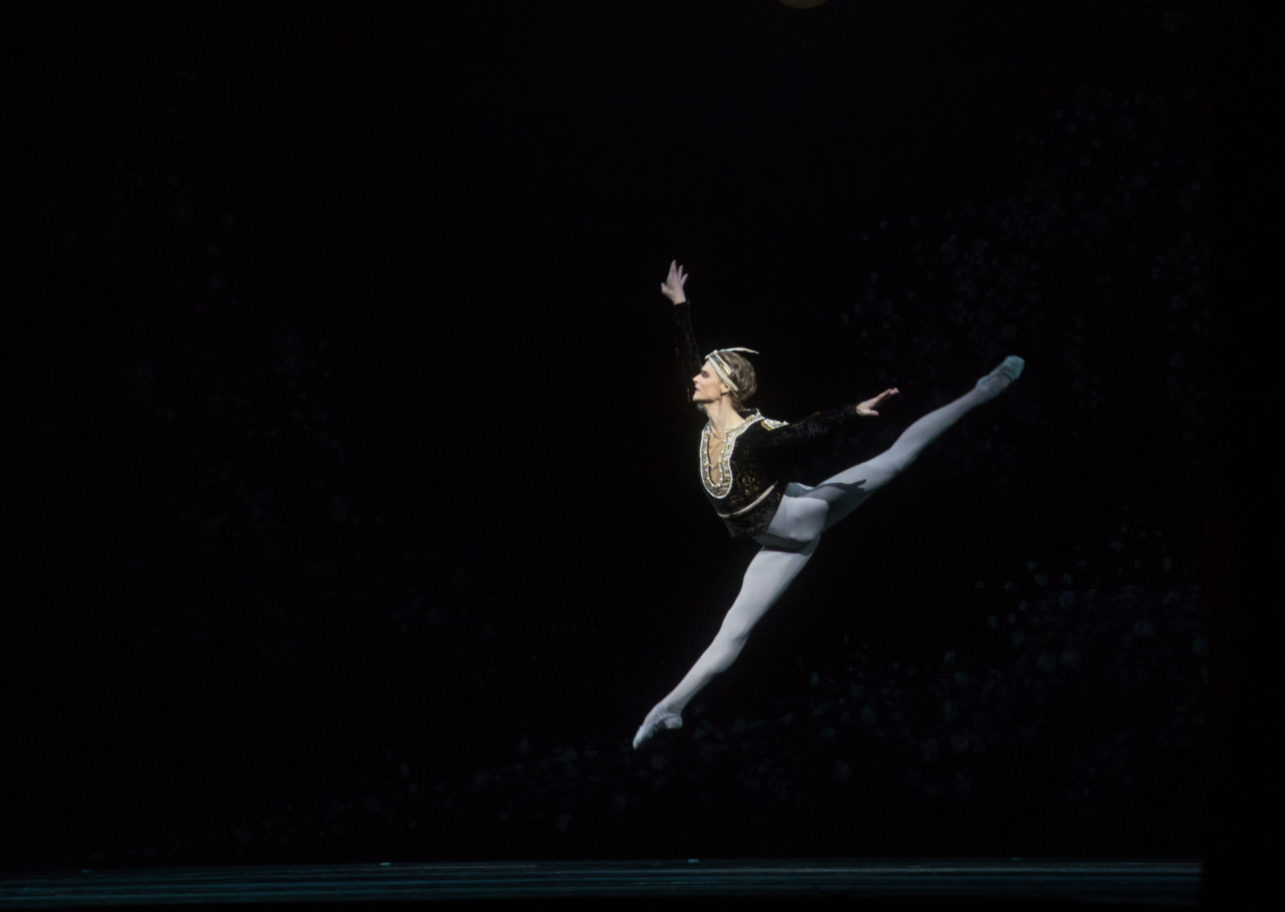
Warriors return from a tiger hunt, escorting Solor, the bravest and most noble warrior of the land. Solor asks to be left alone to pray to the Sacred Fire, but as soon as his retinue departs, he summons the chief fakir, Magdaveya, and requests a secret meeting with the temple dancer Nikiya. Their conversation is interrupted by the arrival of the priests and the High Brahmin, who orders Magdaveya to gather the fakirs in preparation for the Festival of the Sacred Fire.
The bayadères (temple dancers) appear, among them Nikiya, chosen to undergo the rite of initiation and become the High Bayadère. The High Brahmin is struck by her beauty and declares his love for her. Nikiya, however, rejects the advances of a man devoted to the gods. Humiliated by her refusal, the High Brahmin is consumed with anger.
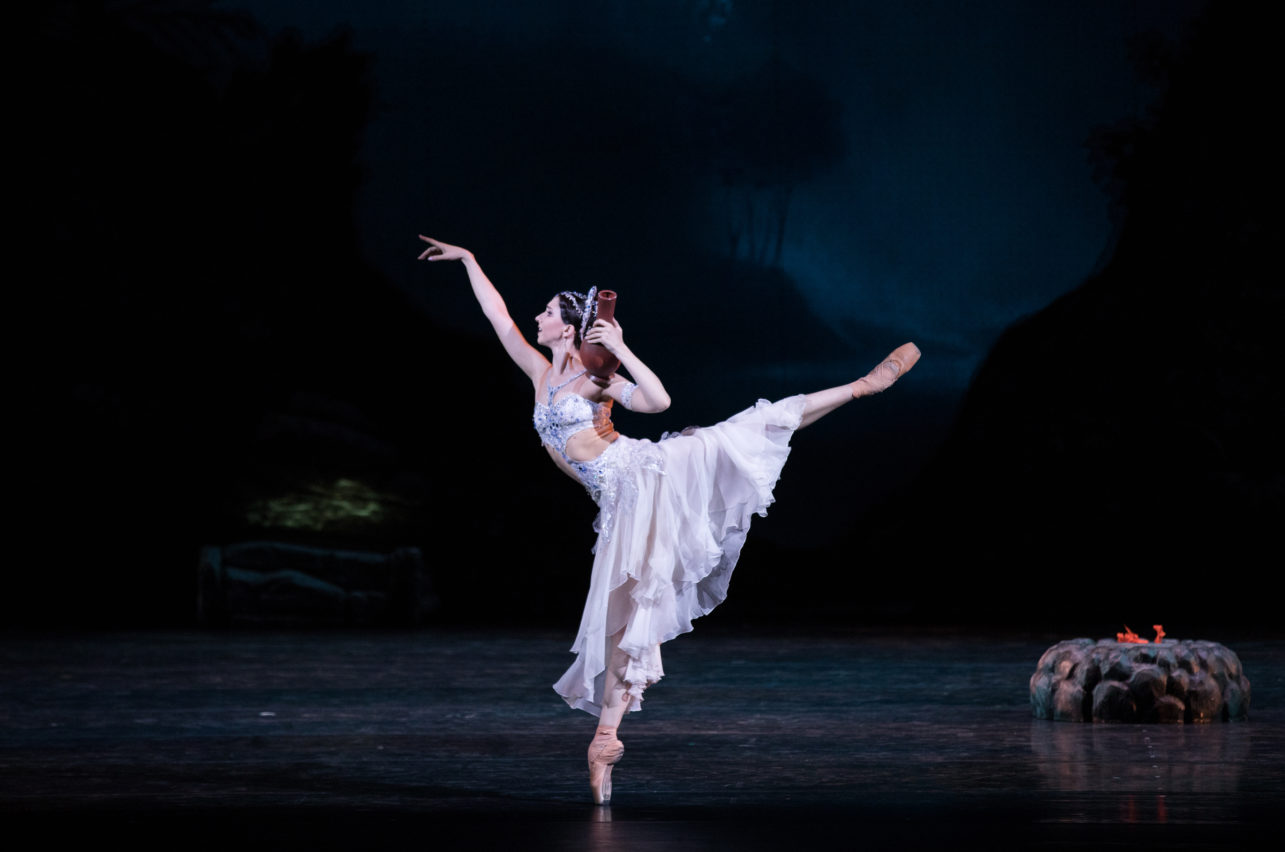
The festival begins. The dancers bring water to the fakirs, and Magdaveya secretly passes Solor’s message to Nikiya. She agrees to meet him but quickly dismisses Magdaveya, fearing the Brahmin’s suspicion. When the ceremony ends, all withdraw into the temple. Magdaveya leads Solor to wait in the forest until Nikiya arrives. Soon she comes, and before the Sacred Fire the lovers swear eternal fidelity. Unseen by them, the High Brahmin witnesses the scene. Enraged, he calls upon the gods to help him destroy Solor.
Scene 2. A Room in the Palace
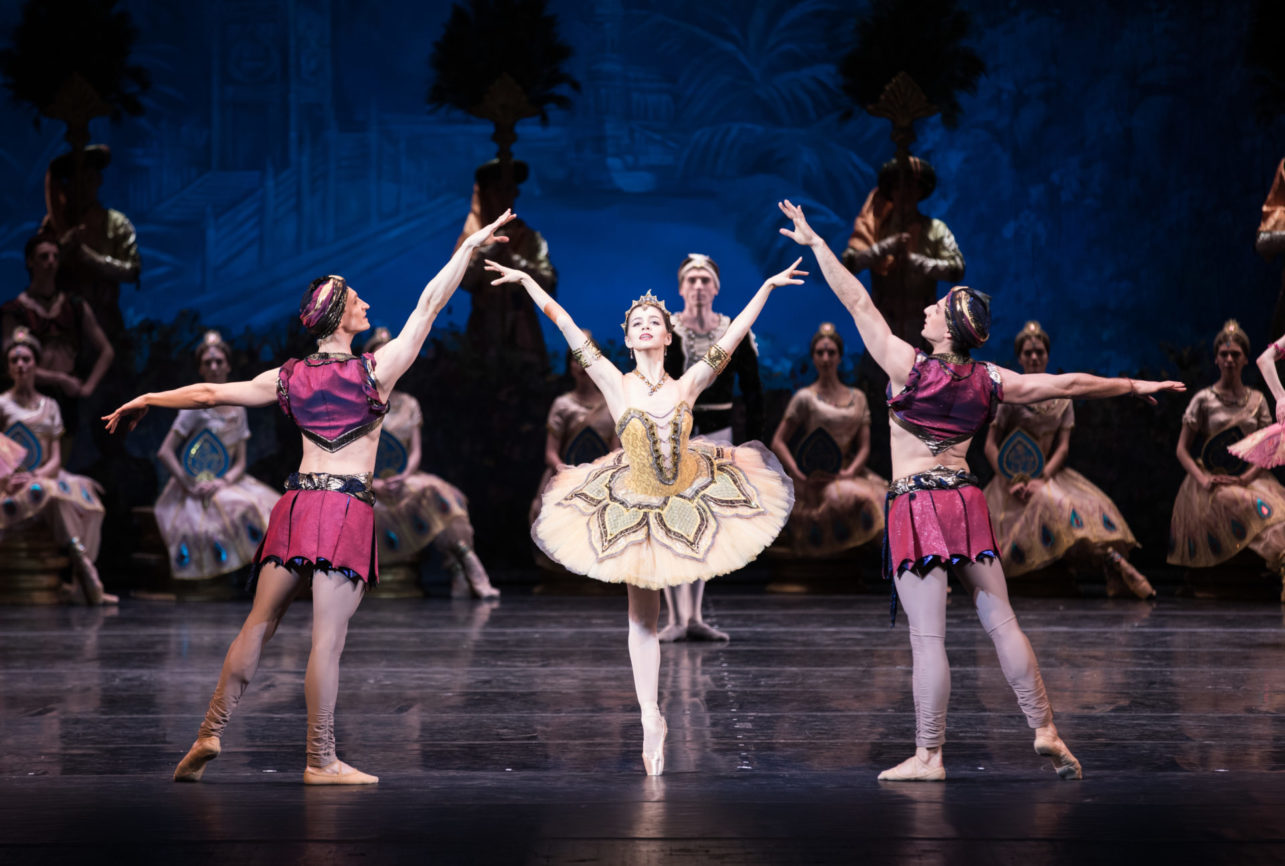
At the palace, Solor is honored for his bravery. The Rajah announces that as a reward, Solor shall marry his daughter, Gamzatti. He unveils her, and Solor is dazzled by her beauty. Despite his vow of eternal love to Nikiya, he falters under the Rajah’s command and Gamzatti’s charms.
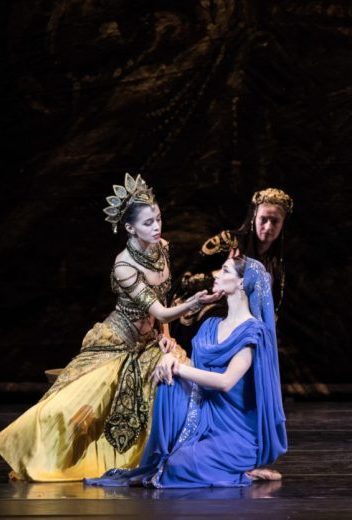
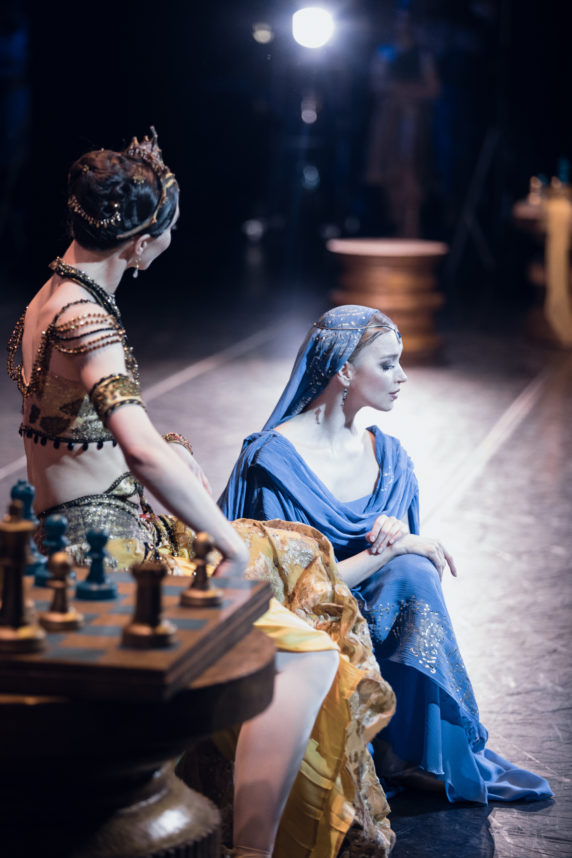
The betrothal celebration is interrupted by the arrival of the High Brahmin. He demands a private audience with the Rajah and reveals Solor’s vow to Nikiya, hoping the Rajah will kill Solor. To his shock and despair, the Rajah instead decides that Nikiya must die. Overhearing their conversation, Gamzatti summons Nikiya. She attempts to bribe the bayadère with gifts and jewels to renounce Solor. Nikiya refuses. In desperation, she seizes a dagger and lunges at the princess, but Gamzatti’s servant Aya restrains her. Horrified, Nikiya flees. Gamzatti, like her father, vows that the bayadère shall perish.
Scene 3. The Palace Garden
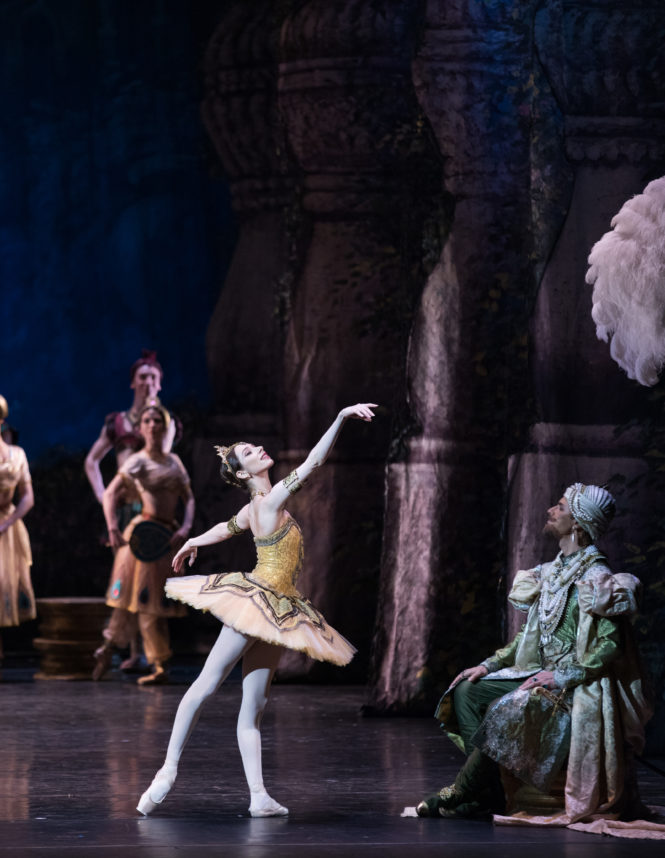
Festivities for the wedding of Gamzatti and Solor take place. The High Brahmin brings Nikiya to perform. Heartbroken, she dances with sorrow and longing. Aya presents her with a basket of flowers, allegedly a gift from Solor. Hope flares in Nikiya’s heart, but hidden in the basket is a venomous snake, placed there by the Rajah and Gamzatti. When Nikiya lifts the flowers to her face, the snake bites her.
The High Brahmin offers an antidote, but as Nikiya sees Solor departing with Gamzatti and the Rajah, she chooses death over life without him.
ACT 2
Scene 1. Solor’s Tent
Crushed by grief over Nikiya’s death, Solor smokes opium brought by Magdaveya in an attempt to ease his sorrow.
Scene 2. The Kingdom of the Shades
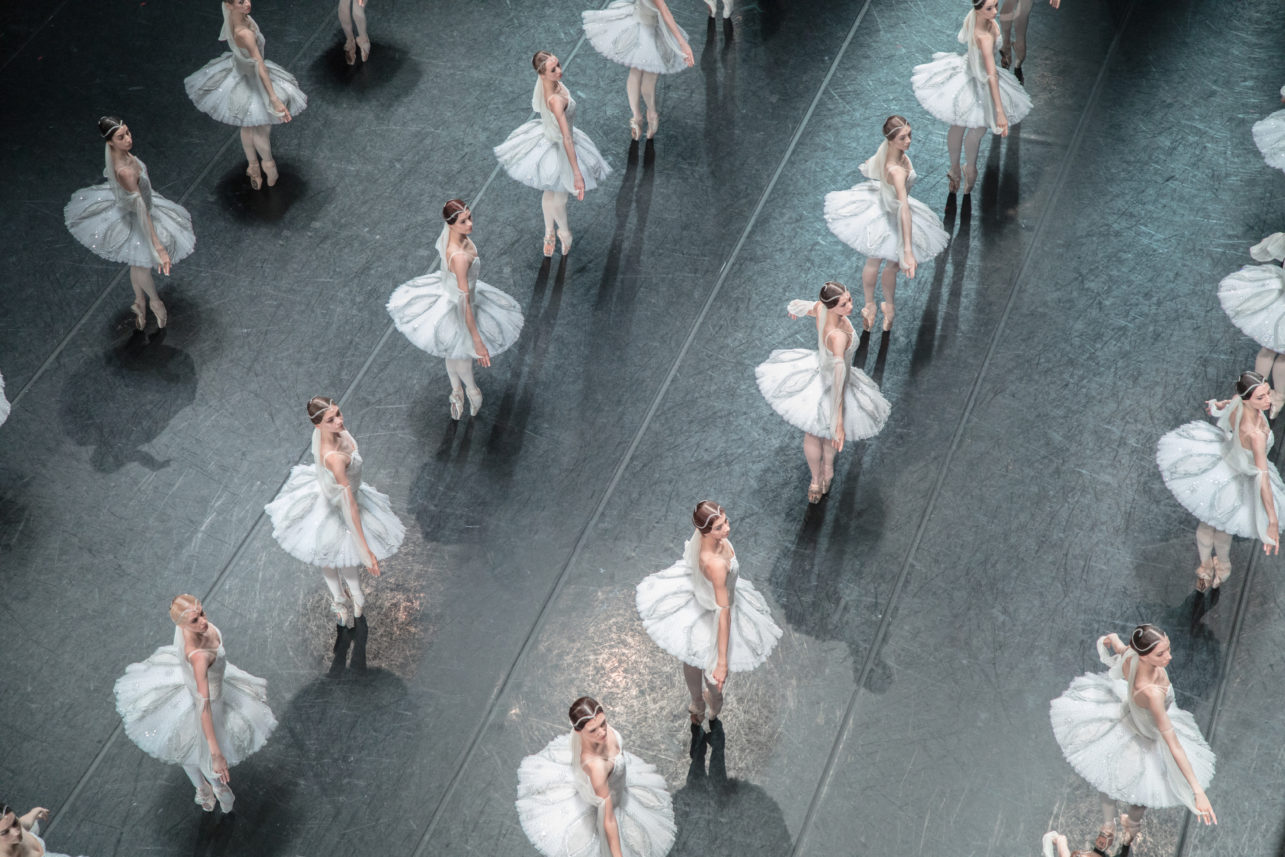
In an opium-induced vision, Solor sees Nikiya’s spirit in the Kingdom of the Shades. Her image multiplies endlessly in a procession of white-clad bayadères. He recalls her dance of love before the Sacred Fire.
Scene 3. Solor’s Tent
Warriors arrive to prepare Solor for his wedding. But Nikiya’s image still haunts him, tormenting his heart.
ACT 3
The Temple
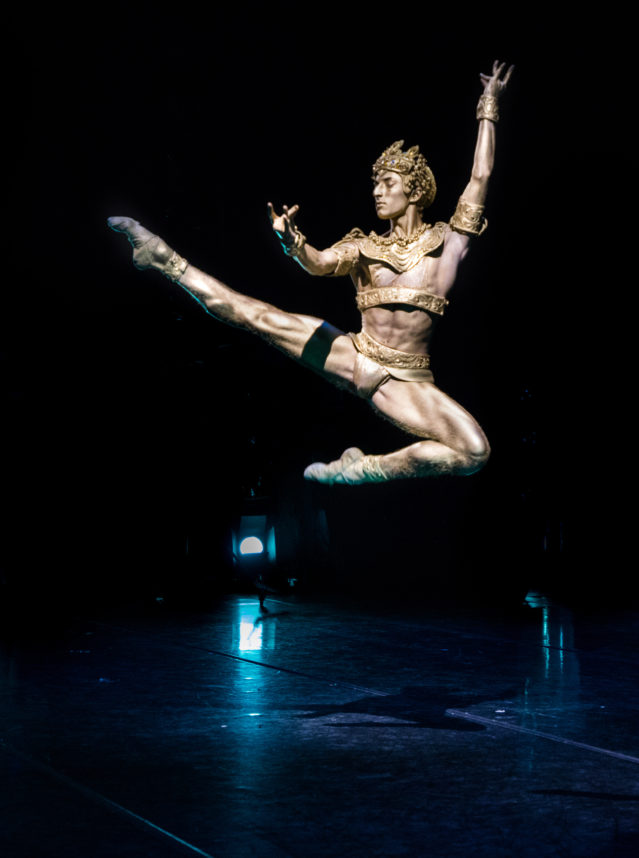
Beneath the statue of the Great Buddha, the Golden Idol dances as the High Brahmin and priests prepare for the wedding of Gamzatti and Solor. The bridal pair enters. Bayadères perform the ritual Candle Dance, symbolizing the Sacred Fire burning outside the temple.
The Rajah, Gamzatti, and Solor join the ceremony, but Solor is pursued by the vision of Nikiya, seen only by him. Suddenly, a basket of flowers appears, identical to the one that caused Nikiya’s death. Stricken with terror and guilt, Gamzatti urges her father to hasten the vows.
At the altar, the High Brahmin begins the rite, but Solor cannot bring himself to pronounce the sacred oath. The gods, enraged, destroy the temple. The building collapses, burying all beneath the ruins.
In eternity, the spirits of Nikiya and Solor are reunited in everlasting love. Ballet "La Bayadere" History
The fires of the French revolution had scarcely flickered out when the bright flame of the Romantic movement began to illuminate and transform the arts in Europe. The romantic movement in ballet was born in Paris on November 21, 1831. The occasion was the premiere of Mayerbeer’s opera Robert le diable which featured a ballet sequence in which white-clad ghosts of dead nuns rose from their tombs and danced a Valse infernale in eerie moonlight. Such an amazing success was this episode - it became overnight the talk of Paris - that the tenor, Adolphe Nourrit who was singing Count Robert, wrote a scenario for a new ballet with a supernatural story, La Sylphide and offered it to the choreographer of the Valse infernale, Filippo Taglioni. Taglioni’s daughter Marie, who had led the nuns in the opera ballet, created the lead role in La Sylphide. There followed a spate of ballets with supernatural themes of which the most famous was Giselle in 1842.
Petipa built his ballet La Bayadère on a strong Romantic base using his own brand of classical aesthetic. Typical of the Romantic period is the choice of exotic locale and the incorporation of ethereal beings. Petipa based La Bayadère on the Indian classics by Kalidasa, Sakuntala and The Cart of Clay. The Kingdom of the Shades seems to have been inspired by Gustav Doré’s illustrations for Dante’s Paradiso. The Kingdom of the Shades is notable in that it extended the frontiers of classical dance, providing an opportunity for the dancers to showcase their pointe technique with classical purity in contrast to the drama that surrounded it. It is regarded as the precursor of the white acts of Swan Lake and Fokine’s famous Les Sylphides. La Bayadère also contained monumental processional scenes including a live elephant and a tiger. (In reference to the opera Aida, La Bayadère was tagged «Giselle, East of Suez.») La Bayadère was first performed at the Maryinsky Theater, St. Petersburg, February 4, 1877.
Although Petipa enjoyed authority as sole ballet master of the St. Petersburg theaters mounting a new ballet was fraught with difficulties. La Bayadère was produced in a period when official policy discouraged the invitation of foreign ballerinas to Russia. Leading Russian dancers were the equivalent technically of their foreign counterparts but did not have the ability to attract the audiences. There were also scheduling problems with the Imperial Italian Opera which monopolized rehearsal time on stage and left only two performances a week for the ballet. The opera also spent a lot of money which placed fiscal restraint on the ballet by theater director Karl Karlovich. It is reported that Petipa and his régisseur spent six months showing artists their individual sections and could only put it all together once on stage. There was only one dress rehearsal.
Despite being a benefit performance for Ekaterina Vazem, with tickets being more expensive than for the opera, the first performance of La Bayadère played to a full house. At the end of the performance the audience applauded for more than half an hour. Among Mme Vazem’s gifts was a ruby broach studded with diamonds, from the public, and flowers from the opera star Adelina Patti. Reviews were uniformly complimentary although they did register complaints of Petipa’s license in dealing with historical facts. They also dwelt on the unavoidable mishaps that befall most first performances. For example in the ‘Kingdom of the Shades’ scene the appearance of a magic palace was mistimed and delayed until after Nikiya had turned to face it.
The original production of La Bayadère did not long survive Ekaterina Vazem’s retirement. Between the premiere and Vazem’s farewell February 17, 1884, it was given approximately 70 performances. Anna Johanson took over the lead role five times in the 1884-85 season. After the second act alone was performed in 1885, La Bayadère was dropped from the repertoire.
In 1900 a revival was mounted to mark the 40th anniversary of dancer Pavel Gerdt’s artistic career. He took the role of Solor in a largely unchanged production. The entrance of the Shades was presented on a darkened stage (originally it had been lit brilliantly), and the number of dancers expanded from 32 to 48. It appears that much of the music was shortened. Although the dancers received glowing reviews, Petipa’s choreography did not fare so well at this outing «perhaps more boring than long and uninteresting.» The ballet was first seen outside Russia (performed by the Kirov Ballet) in London, July 4, 1961 excerpted as The Kingdom of the Shades. it was during this tour that Nureyev defected to the West. Two years later he staged The Kingdom of the Shades for the Royal Ballet.The full length ballet regained popularity with Nathalia Makarova’s sumptuous restaging of the work for the American Ballet Theatre in 1980.
An understanding of ballet productions of the period
It is important to understand how ballets in this period were traditionally put together. The librettist (or author) would select a story or legend that suited his fancy and transpose it into a ballet in five or six acts, regardless of weather it had sufficient dramatic content to support this length. The librettist would also have little acquaintance with either the music, choreography or design. The sole requisite for success was that everything should center on one principal character to be interpreted by the prima ballerina; the slightest incident, the feeblest action, served as excuse for bringing in a dance.
Supernatural female creatures such as sylphs, wilis, shades, water nymphs and later swans, enjoyed great popularity. They appealed to the contemporary taste for idealized, fantasized womanhood and gave an opportunity for abstract choreography for the corps de ballet.
Next a composer was instructed to write the necessary music. It was usually the maître de ballet (choreographer) who set out how many dances were needed in each act, the types of music required (usually easily recognized marches, polkas or waltzes), their length, tempo and beat. If a particular location was indicated by the story, a liberal dose of appropriate national themes or instrumentation was included. The composer was seldom familiar with the libretto, so often the music was not a suitable match for the action. Since dance rehearsals were usually accompanied on the piano, the orchestral coloration of the music was seldom known before the first orchestra rehearsal. Therefore it was not uncommon for a large ensemble piece to be danced to airs lightly scored in the strings, and ethereal moments to be accompanied by the brass.
The maître de ballet tended to hang the dances on a framework, the style and sequence of which were based on established tradition. The prima ballerina must have her pas de deux with variations and coda, and there had to be at least one «pas d’action» for the dancer to display her abilities in mime. The premier danseur also was due his variation, and the corps de ballet had their «ballabiles» to give the principal characters a chance to rest and change costumes. It was also usual to introduce a number of «pas de caractère» for the soloists. It was also an important element to include processions for crowds who countermarched like soldiers, in geometric formations. The scenery and costume designers also worked in a vacuum. Although knowledgeable in historic ornamentation and styles of architecture, the scenic designer’s chief concern was to provide a sense of richness and spaciousness no matter what the subject matter. In almost every ballet there was a lake-side scene, from which convention the members of the corps de ballet in the last row became known as «les ballerines près de l’eau». Convention also demanded that however historically correct the majority of the costumes were, the dancers had to wear a ballet skirt, pink maillot and rose colored ballet shoes. The dancers’ hairstyles always followed the prevailing fashion of the day, often decorated with a diamond tiara. The public saw nothing wrong in a dancer interpreting a humble peasant wearing jeweled bracelets or pearls.
Finally if the leading dancers liked the choreography, all was well and good. If not, the dance could be cut regardless of concern for musical flow, or a dance from another ballet could be inserted.
These notes compiled by Gerard Charles,
BalletMet Columbus, February 1998
© Text 2010 Art and Culture Magazine "St Peterburg" © Bolshoi Theatre Libretto
|
Ludwig Minkus "La Bayadere" Ballet in 3 acts
on the playbill |
Main Stage
Teatralnaya ploschad, 1 (Theatre Square, 1), Moscow, Russia
New Stage
Bol'shaya Dmitrovka Street, 4/2, Moscow, Russia
RAMT
Teatralnaya ploschad, 2 (Theatre Square, 2), Moscow, Russia
|