New Stage
| 13 January |
| 11:00 |
| 2026 | Tuesday |
|
Mariinsky Theatre presents
Nikolai Rimsky-Korsakov "Christmas Eve" Opera in 4 acts. Mariinsky Theatre presents Opera |
|
The performance has 1 intermission Running time: 2 hours 50 minutes
Libretto by Nikolai Rimsky-Korsakov
Musical Director: Valery Gergiev
Lighting Designer: Gleb Filshtinsky
Video Designer: Viktoria Zlotnikova
Principal Chorus Master: Konstantin Rylov
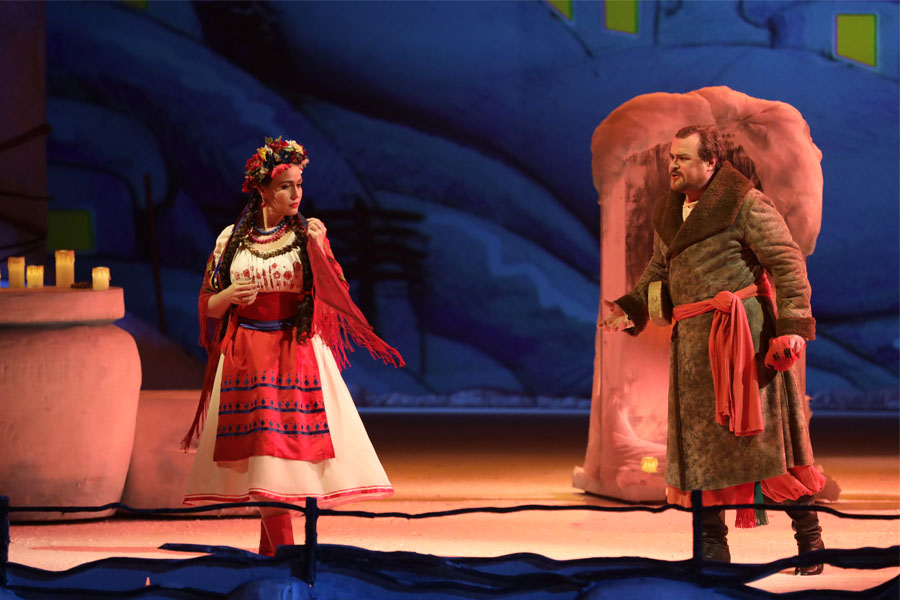
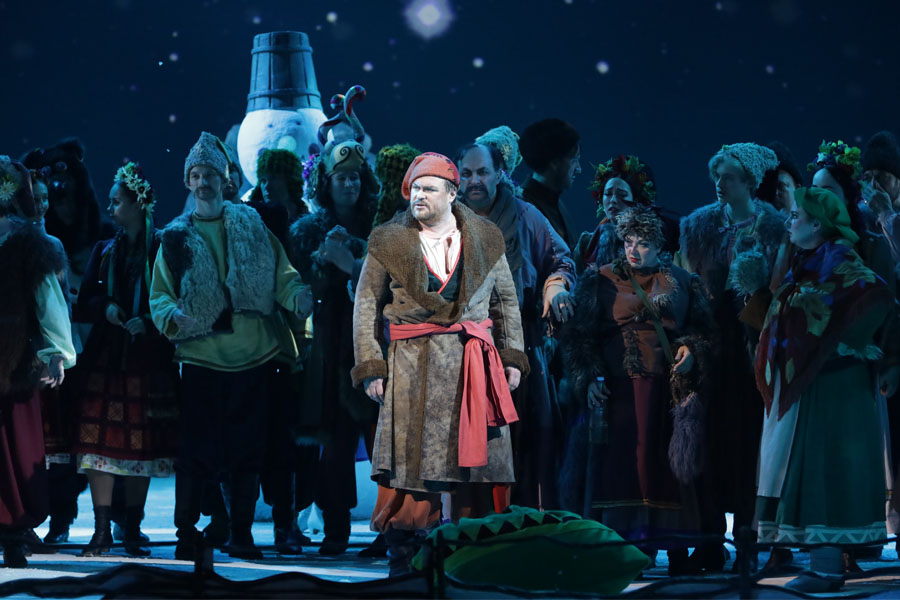
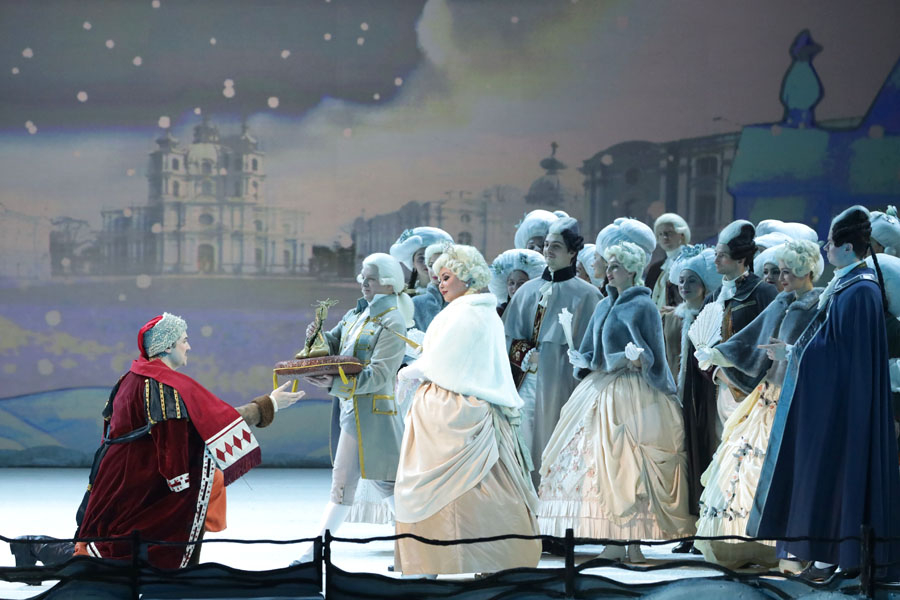
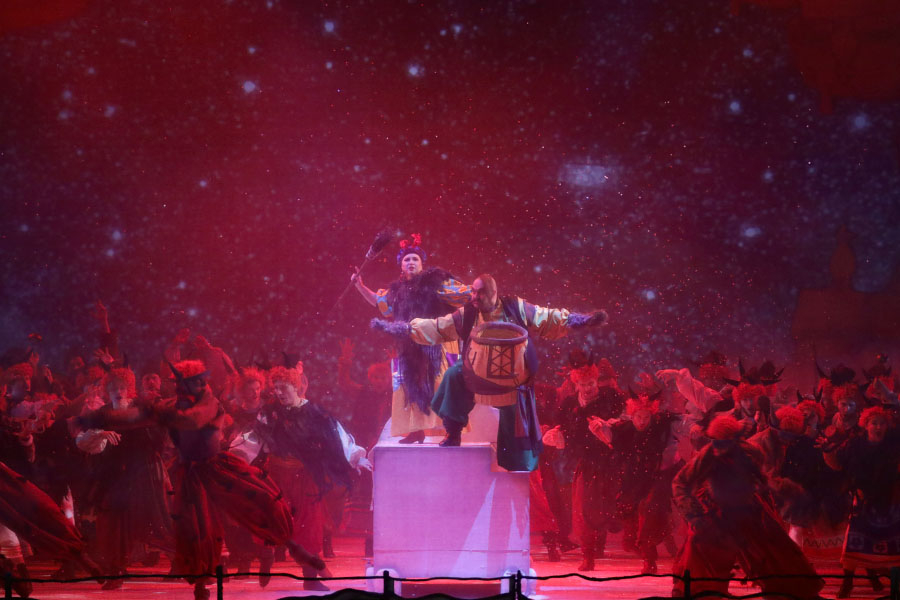
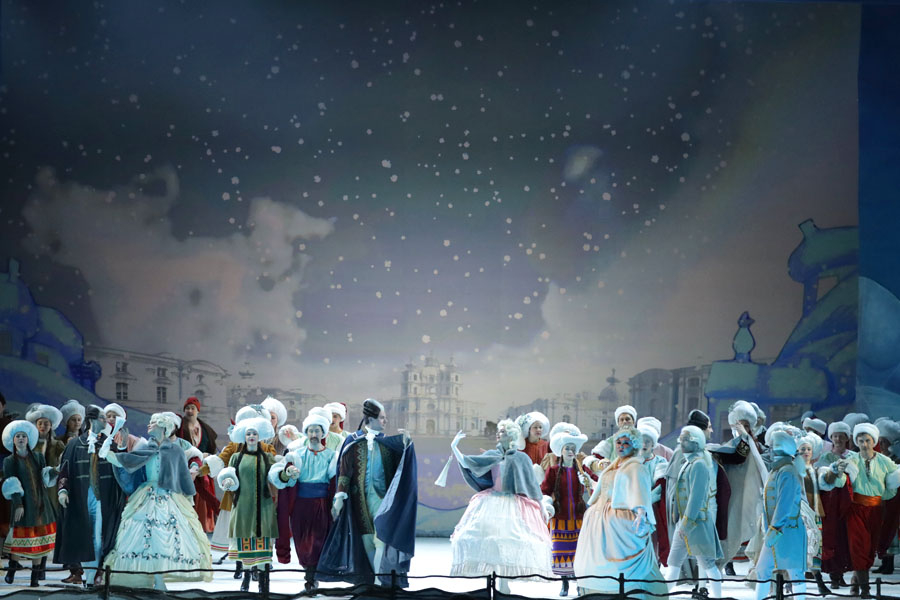
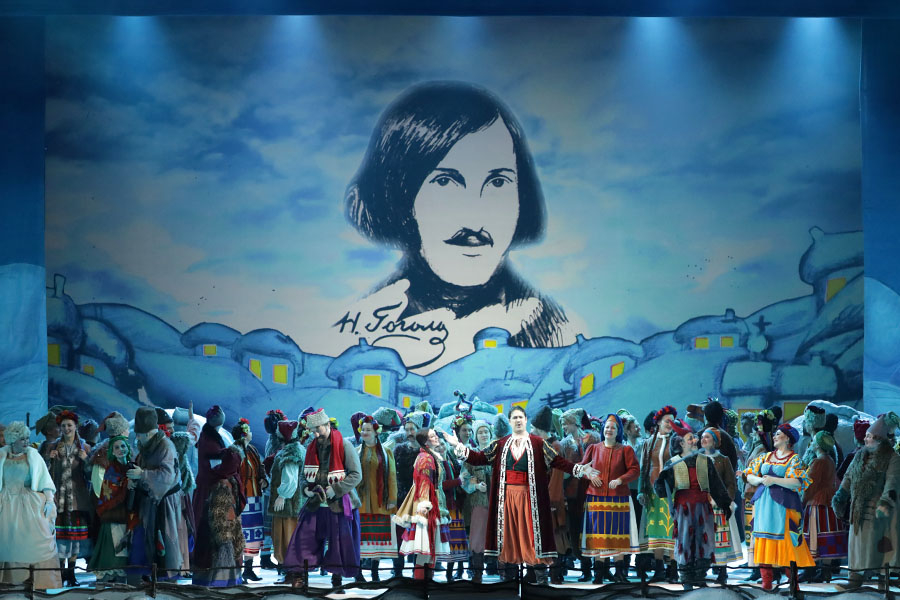
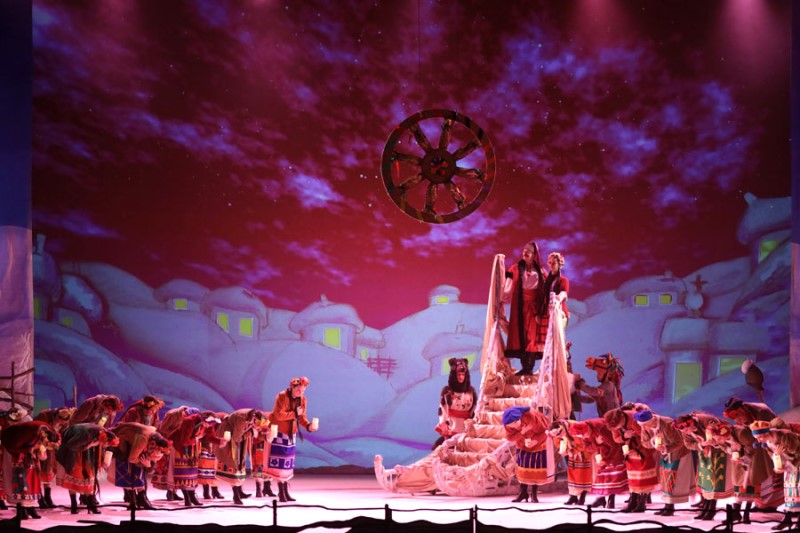
The performance features the set design of the 2008 production (Stage Director: Olga Malikova, Scenography: Xenia Pantina, Costume Designer: Varvara Evchuk)
Premiere of this production: 31 December 2008
Premiere of the new stage version production: 7 January 2021
Premiere at the Bolshoi Theatre: 26 January 2026.
On the history of the opera creation:
Nikolay Rimsky-Korsakov got the idea to write an opera after Gogol`s novel Christmas Eve at the times when Petr Tchaikovsky presented his Blacksmith Vakula under the motto "Art is eternal, life is too short" for a musical competition that he won. Under the competition conditions, the opera which had got the first place was to appear in the repertoire of the Mariinsky Theater. The premiere took place on November 24, 1876. Thirty years later, on December 29, 1906, the second edition of the opera was presented on the same stage under the name Lenticels. On April 29, 1880, another opera after the same story, N. Soloviev`s Vakula, the Blacksmith, which had been created for the same competition that Tchaikovsky won, was shown at the Petersburg Kononov Hall; it was performed by participants of the Music and Drama circle, amateur actors.
Despite the fact that two authors had already addressed the same novel, the magic of this writing would not get off Rimsky-Korsakov`s mind. However, due to the nicety of his character, afraid to afflict Tchaikovsky, Rimsky-Korsakov had never started to write Christmas Eve until after Tchaikovsky`s death. Only in the late spring of 1893 had he begun his work keeping it in secret even from many of his acquaintances.
Keeping most of the novel`s plotlines, Rimsky-Korsakov had supplemented them with many scenes and characters that Gogol had never had. All the previous operas (The Snow Maiden, Mlada, and The May Night) might have preceded the appearance of the semi-pagan rituals in the new writing, which remained in the Christian festivities of the Christmas night; these were the Devil, Witch (Solokha) and Sorcerer (Patsuk), Kolyada and Ovsen, stars and devilry. This way, Gogol`s story became interlaced with the anachronistic pagan legends.
However, later, in his "Chronicles of my musical life" Rimsky-Korsakov noted: "…On the one hand, my libretto was following Gogol strictly, not excluding his language and expressions; on the other hand, it contained in its fantastical part a lot of outside things, enforced by me. For me and those willing to go deeply inside, this connection was obvious; for the public, it turned out to be absolutely obscure, unnecessary and even interfering. My infatuation with myths and putting them along with Gogol`s stories was, no doubt, my mistake, but this mistake did give me a chance to write a lot of interesting music."
Indeed, the music of Christmas Eve created a vast space not only for interpretation of the common life scenes, but also for presenting a fantasy faerie show. A hundred years ago, in the first third of the 19th century, from 1803 to 1807, F. Kauer`s fairy-comic opera The Mermaid after a story of K. F. Gensler, an Austrian writer, had a great success on the stage of the St Petersburg Bolshoy Theater. Interpreted in the Russian mood, it had such a great success that nearly every year its continuation with music of Russian composers, S. Davydov and K. Kavos, appeared on stage. By contemporaries` testimonies, those were grandiose faerie shows with transformations, volcanic fountains, rivers coming out of their shores, an underwater kingdom, monsters and ghosts.
90 years later, Rimsky-Korsakov seemed to have brought the genre of the "magic" opera back on stage, but in a different hypostasis. A true master, he created mythological "portraits" of Slavic daemons and "devilry" creating magnificent contrast musical pictures of Vakula`s flight on a devil to Petersburg and his return to Dikanka. We get a nearly physical and phonic feeling of the frosty air, the beauty of the calm winter sky, the round dance of stars and celestial bodies, the magic picture of the dawn, and, all of sudden, the rushing in rasp and howl of the devilish chase. These magnificent musical sketches have always been arousing directing, choreographic and scenographic fantasy of the producers, opening immense freedom for the most incredible stage solutions.
M. Godlevskaya SynopsisThe action unfolds on the outskirts of the village of Dikanka in Ukraine in the 18th century.
Act I
On the last night before Christmas, the witch Solokha begins to chant kolyady in accordance with an ancient custom.
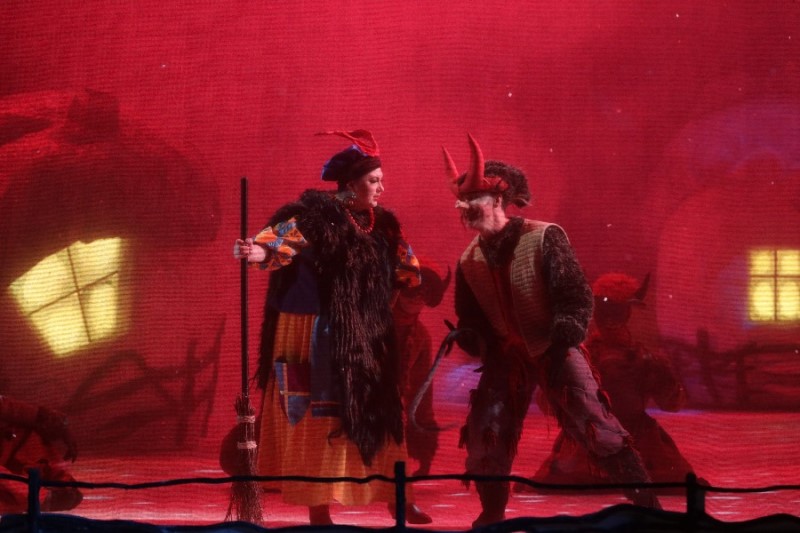
Suddenly, however, her friend appears – the Devil. He is absolutely furious with her son Vakula as "the day before he painted the Devil for a laugh, being chased by branches and switches of twigs." Having resolved to make things difficult for him, the Devil persuades Solokha to steal the moon and cause a snowstorm. It will then become dark, Chub will remain at home beside the hearth and Vakula will be unable to visit his daughter, the beautiful Oxana. Solokha agrees. Chub is dearer to her than all the Cossacks of Dikanka: he is a widower and he is rich, and she is not averse to laying her hands on his wealth. Solokha and the Devil cause a snowstorm and steal the moon. Panas, who has had a little too much to drink, comes out of the inn and sets out for Chub's house, resolving to continue the Christmas Eve festivities there. But Chub himself comes out and calls on Panas to join him for Christmas pudding at the Deacon's. There will be tasty brandy with saffron there. The snowstorm worsens, and Panas and Chub lose their way.
Vakula is unable to sleep either. Anxiously, he paces around Chub's house: how can he learn whether or not the proud Oxana loves him?
Having got lost in the dark, Panas returns to the inn, but Chub, having strayed and been unable to find the Deacon's house, goes home. But he finds Vakula at his house. "No, it's not my house, the smith will not enter my house," Chub resolves and sets out to visit Solokha. And Vakula, by now having cast off all doubts, plans to declare his love for Oxana. The snowstorm breaks up.
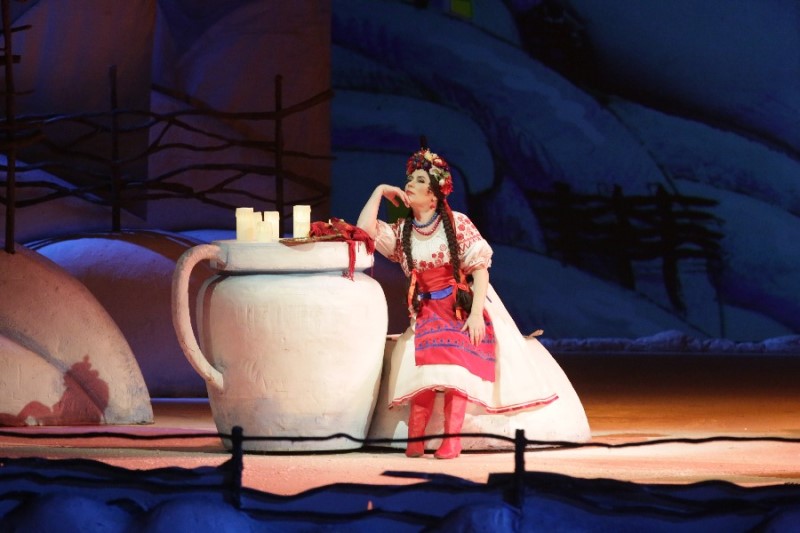
Oxana admires herself in the mirror. Vakula, having entered unseen, is enchanted by her beauty. But it is not so easy to win her heart. She teases Vakula, as if she is bored with him, and she waits for her friends to come and sing carols, because there will be boys there – "great stories will be told." And there they are now!
One of her friends, Odarka, is wearing new high-heeled boots. Oxana laments that no-one will give her such a present. In answer to Vakula's promise to get her any boots that she desires, before everyone Oxana declares "If he gets me the boots worn by our Empress Mother herself then I will marry him!"
Frozen from the cold, Solokha and the Devil warm themselves up indoors, singing and dancing. Unexpectedly, there is a thunderous knocking at the door. Solokha only just succeeds in concealing the Devil in a sack when the Village Elder enters. He has been summoned for Christmas pudding at the Deacon's, but having seen a light in Solokha's house he decides to spend the evening with her. He has just drunk a glass of vodka when there is more knocking. Solokha hides the Elder, shoving him into another sack, and admits the Deacon. Having decided not to wait for his guests who must be afraid of the snowstorm, the Deacon had the happy idea of coming to see Solokha. But his attentions are interrupted by a loud knocking. It is Chub. Having quickly hidden the Deacon in the final sack, Solokha warmly welcomes this desired guest.
Unexpectedly, however, Vakula returns home. Half frightened to death, Solokha hides Chub in the same sack already holding the Deacon. Vakula wishes to take the sacks out of the house – because "tomorrow is a holy day". The smith hoists the sacks onto his back and sets off for the forge.
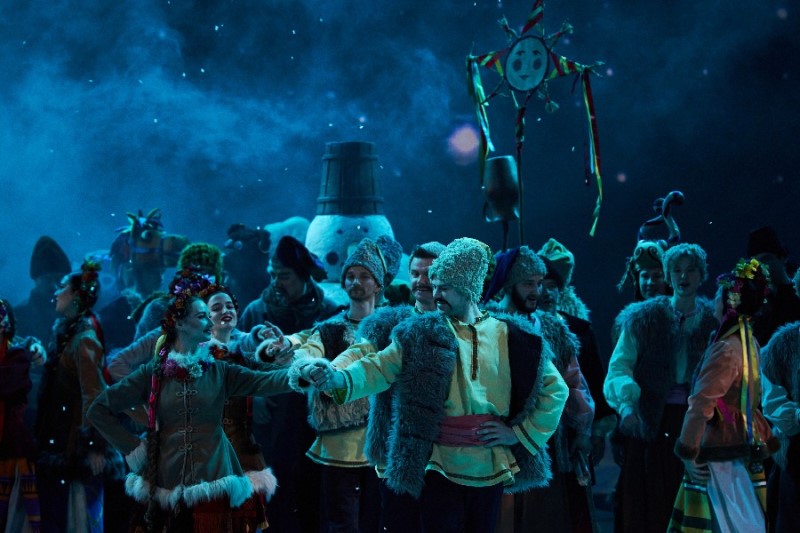
On this Holy Night the young men and women are having fun. There are games, jokes and dressing-up fun. The drunken Panas is capering around. Oxana, too, is having fun. On seeing Vakula, she tells him once again: "Get the boots, smith, and I will marry you!" But Vakula no longer wishes to be deceived by the proud girl; he decides to leave the village.
All are perturbed: has the smith's reason been touched, might he not harm himself in his grief? The Woman with the Normal Nose and the Woman with the Purplish Nose rush off to spread a rumour throughout the village: one that the smith has hanged himself, the other that "the poor soul has thrown himself into an ice-hole." Oxana, too, is worried – what if, in his anguish, he falls in love with another girl and starts calling her the most beautiful! But here she espies the sacks left by Vakula. The young people untie them. One after another, Solokha's confused admirers emerge from the sacks – Chub, the Elder and the Deacon. The crowd erupts into unrestrained laughter.
Act II
Vakula, taking only a small sack with him, departs to get advice from the old sorcerer Patsyuk. There is talk that he knows all the devils. The smith asks Patsyuk to show him the way to the Devil: only he can assist him in his grief. "It is not far to the one on whose shoulders the Devil sits," Patsyuk calmly answers. The amazed Vakula sees how the Devil pops out of the sack, willing to help him if the smith will sell his soul. Pretending to sign a note in blood, Vakula suddenly grasps the Devil by his tail and produces a crucifix. Threatened by the sign of the cross, the Devil promises the smith to do everything he wishes. Vakula orders that he be brought to the Empress, and they set off.
An ethereal space. There are songs and dances of the stars. The planets soar in the sky. Witches, sorceresses and hags of Kiev are assembling for their Sabbath. Patsyuk and Solokha are among the evil spirits. They are singing a chant of madness. On seeing Vakula with the Devil, they attempt to block the smith's path, but he holds a crucifix firmly in his hand.
There are fanfares, people are running about and the young men and women are in great uproar – now they are to see St Petersburg and the Empress herself. The Court ladies, gentlemen and Zaporozhians harmoniously perform a polonaise. The Empress herself appears. Vakula falls at her feet: "If only my woman had such boots to wear!" The Empress likes the smith's simple style of speech. She will present him with her finest boots! Christmas Eve is approaching its end. Soon the sun will rise. Without a backwards glance, the evil spirits flee from the dawn, Vakula is carried back by the Devil, the precious cargo for Oxana in his arms. It becomes light. The girls come out, spinning a wheel – a symbol of the sun, a symbol of the earth's fecundity, of light and of life. Kolyada appears in a golden carriage, met in return by Ovsen in the form of a handsome youth. Church bells ring out – Christmas and Love have come to the world.
Act III
Oxana is sad; she has already come to understand that there is no lad who loved her as much as Vakula. Since morning the two women have been chattering that the smith has hanged himself and has drowned himself. Having argued to the point of fighting, the women run away. Chub also makes his way home.
Oxana is left alone and does not notice Vakula, who finally hears that she "has fallen in love" with him. The beautiful girl no longer needs the boots – she is ready to marry the smith without them. Chub, too, agrees to this: he cannot forget the treacherous Solokha, and Vakula's gifts from St Petersburg – a colourful belt and an astrakhan hat – are so very fine!
Chub summons the people of Dikanka – soon there will be a wedding! All are delighted at Vakula's return.
|
|
Main Stage
Teatralnaya ploschad, 1 (Theatre Square, 1), Moscow, Russia
New Stage
Bol'shaya Dmitrovka Street, 4/2, Moscow, Russia
RAMT
Teatralnaya ploschad, 2 (Theatre Square, 2), Moscow, Russia
|